The Birdsey household’s abusive environment
I Know This Much Is TrueThe Birdsey household’s abusive environment is a system of fear and unequal power, not a single outburst: Ray insults and intimidates the family, punishes the twins in ways that fall more harshly on Thomas Birdsey, and makes Ma’s security and the boys’ future depend on his approval. Recounting this history to Joy, Dominick Birdsey recognizes both the lasting force of Ray’s cruelty and the limits of using it to explain Thomas’s illness. The family’s silence and endurance are part of the damage; so is the difference between the brother who could sometimes resist and the brother who was made to suffer visibly.
A home governed by intimidation
Dominick remembers Ray as more often a screamer than a hitter, a man who called the boys human garbage and told Ma she would still be struggling alone with her two children if he had not married her. The insults placed everyone’s dependence on him in the foreground: Ray presented himself as the person who had rescued the family, then used that supposed debt to justify contempt. His anger could also become physically forceful. At the supper-table argument over the twins’ future, he struck the tabletop with his fist hard enough to make the dishes jump, then left the house. When he returned, he spoke to the boys only in single syllables and would not speak to Ma for days.
This pattern made family life unpredictable and narrowed the room for disagreement. Ma challenged Ray over whether the twins should go to college; his response was not simply to argue the merits of school, but to accuse the boys of taking from him and announce that he was fed up. The silent treatment that followed extended the conflict beyond the meal and into the household’s ordinary days. Anger, withdrawal, and the threat of withholding support worked together: Ray could punish the family through speech, silence, and control over money.
Punishment and the unequal treatment of the twins
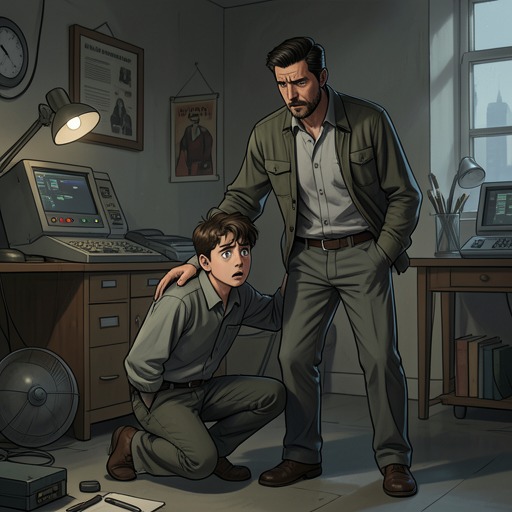
The memories Dominick shares with Joy show how Ray’s discipline turned ordinary behavior into a pretext for humiliation. Thomas sometimes chewed pencils, napkins, or his shirt sleeves without noticing. Ray watched for the behavior, treated it as a major offense, and one evening went down to the cellar for duct tape. He covered Thomas’s fingers so that Thomas could not chew them and made him wear the tape for at least a couple of days. Dominick recalls Thomas eating with his head lowered over his plate and whimpering through the ordeal. The punishment targeted a nervous habit by restraining Thomas’s hands, turning a child’s involuntary action into a spectacle of helplessness.
On another occasion, Ray made both boys kneel on rice scattered across the kitchen floor. Dominick cannot remember what offense had led to the punishment; what remains vivid is the difference in how it ended. After about fifteen minutes, Ray let Dominick get up because he had not cried. Thomas, who was bawling, had to remain kneeling. In Ray’s household, visible pain did not bring comfort: crying was treated as the greater offense, because it let an enemy see weakness. The episode makes the family’s code of toughness concrete. Endurance earned release, while distress prolonged the punishment.
Dominick says Ray could be brutal with Thomas and that Dominick himself was also targeted, though never as badly. He cannot explain the difference with certainty. He remembers having made Little League all-stars while Thomas quit midseason, and spending time watching Ray change the oil in his car; these are possibilities he considers, not a settled explanation. He also recalls being the only one of the three—Ma and the twins—who would stand up to Ray. In his view, that resistance may have spared him some of the worst treatment, while leaving Thomas more exposed.
Ma, fear, and the cost of dependence
Dominick describes Ma as more frightened of Ray than either boy was, and says she allowed him to get away with his conduct because she was afraid. That fear surfaces again when she challenges his opposition to paying for college. Ray insists that two able-bodied young men should work, enlist in the Navy, or seek apprentice jobs at Electric Boat rather than expect their family to fund higher education. He frames the issue as the twins taking without giving, while Ma insists that their schooling matters.
When Ray says no one would hire Ma, she answers by applying for a maid’s job at Howard Johnson’s. She is afraid of working outside the home, of making mistakes, and of strangers judging her cleft lip, but the restaurant offers her the position after an interview. On her first morning, in her yellow uniform and visibly shaking as she cooks breakfast, she is taunted by Ray with warnings about the people and messes she will have to deal with. The prospect of Ma earning money makes the argument immediate: only then does Ray agree to provide four thousand dollars for the twins’ college education and allow her to remain at home.
Ma is relieved not to enter the job, but ashamed that she does not show up. She sends Dominick to return the uniform. The man at the desk mocks her by calling into its empty collar, and Dominick makes no objection; he may even have smiled. Outside, however, he kicks the tire of Ray’s Fairlane hard enough to break his toe. He understands that it is Ray, rather than the tire or the clerk, whom he is trying to strike. The episode links Ray’s control of the money to Ma’s humiliation and to Dominick’s anger, which finds an outlet in a displaced act of violence. Ray’s contribution, student loans, and the boys’ part-time earnings eventually make college possible, but Dominick remembers that Ma had been made to beg for the help.
Memory, illness, and the limits of blame
Dominick tells Joy these stories while shredding the foil wrapper from her Pop Tart without noticing what his hands are doing. Her attention draws him into a family history he calls ancient, but the details remain sharply present: the tape around Thomas’s fingers, his head lowered over his plate, the rice on the kitchen floor, and the days of silence after Ray’s argument with Ma. The small, unconscious act of shredding the wrapper accompanies the difficulty of opening up; Joy’s response gives Dominick space to continue.
When Joy suggests that Ray’s treatment may explain why Thomas became so unwell, Dominick rejects a simple causal account. He admits that he once liked making Ray the villain and wishing him dead, and that he too used to think what Thomas endured at home had made him break down. He does not excuse Ray: Ray did not help the situation. But Dominick distinguishes abuse from the cause of Thomas’s illness, describing the illness as biological and chemical. That distinction does not make the punishments less cruel. It instead marks the tension in Dominick’s recollection: the household’s violence belongs to Thomas’s history, yet it cannot serve as a complete explanation for his mind or reduce Ray’s responsibility to a single origin story.